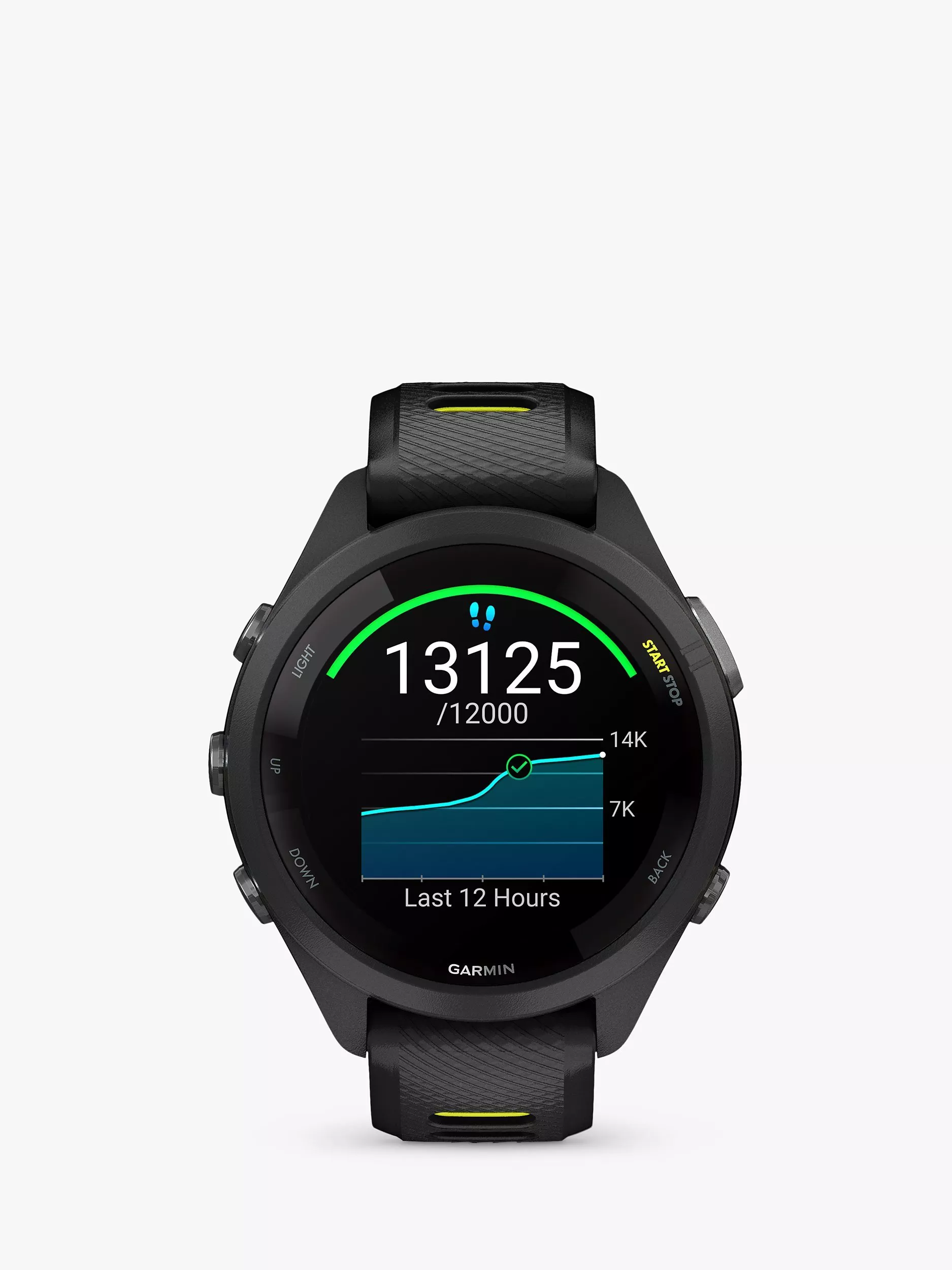
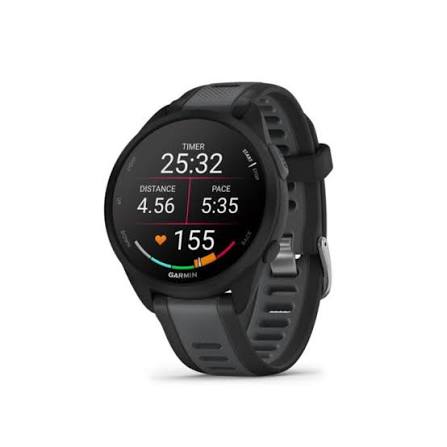
The Forerunner 165 and 265 are quite close in everyday use, but the 265 is aimed much more at structured training and serious runners.
Garmin 165 vs 265
| Feature | Forerunner 165 | Forerunner 265 |
|---|---|---|
| Display | 1.2″ AMOLED | 1.3″ AMOLED |
| GPS | Standard GPS | Multi-band GPS + SatIQ |
| Battery, smartwatch | Up to 11 days | Up to 13 days |
| Battery, GPS | Up to 19 h | Up to 20 h |
| Weight | ~39 g | ~47 g |
| Touchscreen | ✅ | ✅ |
| Buttons | 5 | 5 |
| Running power | ✅ | ✅ |
| Running dynamics | ✅ | ✅ |
| Training Readiness | ❌ | ✅ |
| Training Status | ❌ | ✅ |
| Training Load/Load Focus | ❌ | ✅ |
| Triathlon mode | ❌ | ✅ |
| Multiband GPS | ❌ | ✅ |
| Garmin Pay | ✅ | ✅ |
| Music | Music version only | ✅ |
| Water resistance | 5 ATM | 5 ATM |
Garmin itself positions the 165 as an entry-level GPS running watch, and the 265 as a mid-level/advanced running watch.
Check price on Amazon

👑 Our Winner: Garmin Forerunner 265
- Better overall running watch, with a more advanced training toolkit
- Training Readiness, a multiband GPS system, and a richer set of performance metrics
Not sure in your choice? Use our Shoe Finder tool,to make decision.
🏃 Forerunner 165 — what it’s really good at
The 165 gives you essentially everything a normal runner needs:
- GPS distance and pace
- Heart rate
- VO₂ max
- Recovery time
- Race predictions
- Daily suggested workouts
- Garmin Coach
- PacePro
- Running power
- Running dynamics
- Sleep and HRV tracking
- Body Battery
- Morning Report
- AMOLED touchscreen
- Garmin Pay
Garmin specifically lists running power, cadence, stride length and ground-contact metrics among the 165’s capabilities.
If you’re running 5K, 10K or even a half marathon, the 165 is already a very capable watch.
🏃♂️ Forerunner 265 — where the extra money goes
The biggest difference isn’t the screen. It’s the training ecosystem.
The 265 adds things such as:
Training Readiness — combines factors such as sleep, recovery and training load to help indicate how prepared you are for training.
Training Status — gives you a broader picture of how your training is affecting your fitness.
Training Load / Load Focus — lets you look at how much training you’re doing and the types of training you’re accumulating.
Multiband GPS — particularly useful around tall buildings, dense trees and other difficult GPS environments. Garmin’s 265 documentation confirms All + Multi-Band GPS capability.
Triathlon profile — important if you also swim and cycle and want proper multisport workouts.
The 265 also has 8 GB storage versus 4 GB on the 165.
GPS is one of the biggest differences
If you mostly run in open areas, you may not notice much.
But if you run through cities, forests or areas with tall buildings, the 265’s multiband GPS can be a meaningful advantage.
The 165 still has good GPS; you’re not getting a “bad GPS watch” by buying it. The 265 simply has more sophisticated positioning hardware.
Battery
Interestingly, the difference isn’t huge.
165:
- Up to 11 days smartwatch
- Up to 19 hours GPS
265:
- Up to 13 days smartwatch
- Up to 20 hours GPS
- Up to 14 hours with All + Multi-Band GPS on the 46 mm model
What is you experience with Garmin?
Tell us in comment.
Leave a Reply