Jungfrau Marathon is one of Europe’s most spectacular—and toughest—marathons.
📅 Date: Saturday, 5 September 2026
📍 Start: Interlaken, Switzerland
🏁 Finish: Eigergletscher, near Kleine Scheidegg
📏 Distance: 42.195 km
⛰️ Elevation gain: about 1,953 m
🕣 Start: 08:30
🏔️ What makes it special?
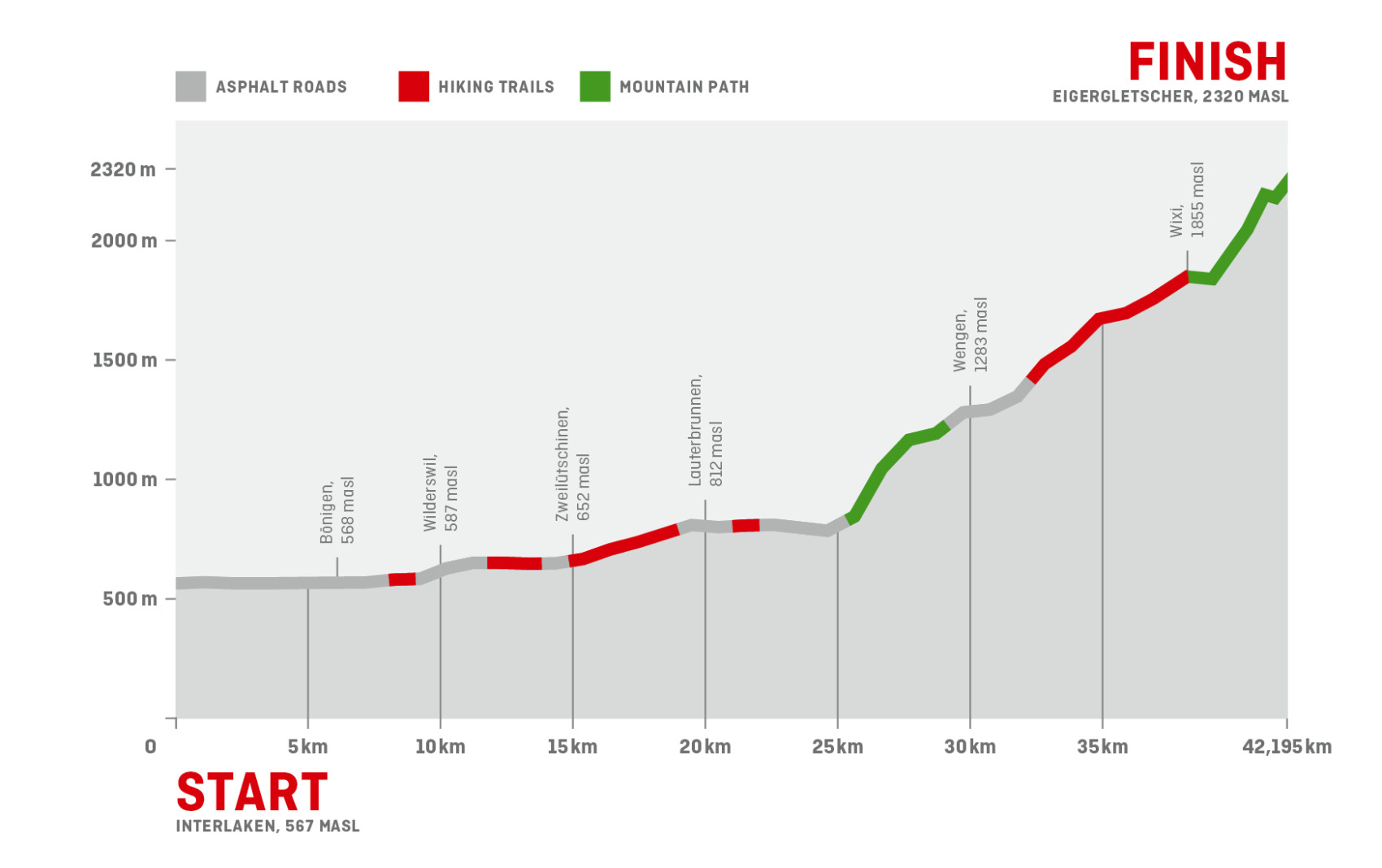
This isn’t a normal road marathon. The route starts in Interlaken and climbs through Lauterbrunnen and Wengen, eventually reaching the Eigergletscher at high altitude. You get spectacular views of the Eiger, Mönch and Jungfrau along the way.
The final climb is particularly demanding, so I’d consider it a mountain marathon rather than a conventional 42 km race.
🎟️ Registration
There are 4,000 marathon places. Registration opened on 14 February 2026 on a first-come, first-served basis, and the organizers reported that places usually disappear quickly.
There is also a Jungfrau Marathon package that includes a guaranteed race place plus 2–4 hotel nights and breakfast, starting from CHF 357
🗺️ The route
The course is essentially a long progression from the valley into the Alps:
Interlaken → Wilderswil → Zweilütschinen → Lauterbrunnen → Wengen → Wengernalp → Kleine Scheidegg → Eigergletscher
Some important points:
- 10 km: Wilderswil
- 20.8 km: Lauterbrunnen
- 30.7 km: Wengen
- 38.5 km: Wixi/Wengernalp junction
- 42.195 km: Eigergletscher finish
The really difficult part comes after the halfway point. You’re still climbing substantially when many road-marathon runners would normally be trying to accelerate
🏃 What sort of runner is it suitable for?
If you can comfortably run a 4:00–4:30 flat marathon, that doesn’t automatically mean Jungfrau will be easy.
I’d rather see someone with:
Good preparation
- regular long runs of 25–32 km
- substantial hill training
- hiking/running uphill
- strong quads and calves
- experience with long descents
- ability to keep moving for 5–6 hours
A runner who is slower on flat roads but has strong mountain endurance may actually be better suited.
🥾 Training
For this race, I’d change a normal marathon plan considerably.
A good preparation would include 1–2 hill sessions per week, for example:
- long uphill treadmill sessions
- mountain hiking
- trail running
- hill repeats
- long runs with 500–1,000+ m of elevation gain
Also train your downhill running. The muscles used to descend for a long time can become extremely fatigued.
Have you ever run on Jungfrau Marathon?
Please,share us your previous experience with us in the comments.
Leave a Reply